
When an employer or nonprofit receives a clear national background check result, it can be tempting to assume the
applicant has no criminal history anywhere in the United States. But a clear national criminal database search means
something more specific: no reportable match was identified within the data searched under the search parameters
used. It does not establish that every courthouse in the country was checked.
Understanding that distinction can help organizations make more informed screening decisions, especially when
employees or volunteers work with children, vulnerable populations, sensitive information, or other high-trust
responsibilities.
Not All Counties Report Criminal Records to National Databases
One of the biggest misconceptions about a national background check is that it searches criminal records
from every county in the United States. It does not.
Commercial national criminal databases aggregate records from a variety of sources, but not all counties
contribute records. Some jurisdictions may not be represented, while others may supply only certain records or
update information at different intervals. Participation and coverage can also change over time.
That means an applicant could have a criminal conviction in a county whose records are not included in the
database, and the national criminal database search could still return a clear result. Even when a county is
represented, recent cases, missing details, or delayed updates may prevent a record from appearing.
A clear national database result does not necessarily mean a clear criminal history. The result describes what
was found in the sources searched—not every criminal record that may exist.
What Does a National Background Check Actually Search?
A national criminal database search typically draws information from multiple participating sources, which may
include state repositories, court records, corrections agencies, and other criminal justice sources. Its broad
geographic reach makes it a useful discovery tool, particularly when a person has lived or worked in multiple
locations.
However, there is no single commercial database containing every criminal case from every county and court. A
national database search can be useful without being comprehensive on its own.
Why Else Can a National Criminal Database Return a Clear Result?
- Reporting and coverage gaps: Some counties do not contribute records, and others contribute only limited data.
- Update delays: A case may exist at a courthouse before it appears in an aggregated database.
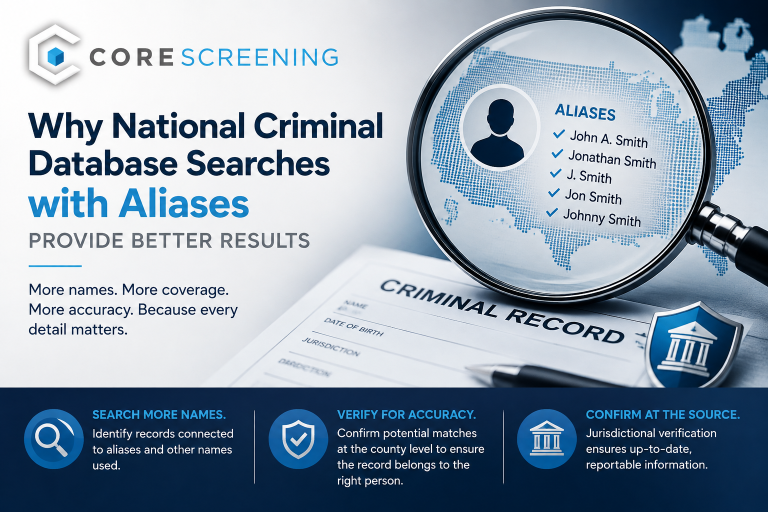
- Name variations: Records may be associated with a previous legal name or another name variation not searched.
- Different court systems: Federal criminal cases generally require a separate federal court search.
- Matching limitations: Missing or inconsistent identifiers may prevent a potential record from being identified
reliably.
How Are County Courthouse Searches Different?
A county criminal search examines records available through a specific county court system rather than relying only
on an aggregated national database. Depending on the jurisdiction, it may use electronic court access or require a
researcher to obtain information from the court.
County searches can uncover records absent from a national database and may provide more current case details
and dispositions. Access, completeness, fees, and turnaround times still vary by jurisdiction. A county search does
not cover every court nationwide, and federal cases generally require a separate search.
For many screening programs, appropriately selected county or statewide searches combined with a national
criminal database search provide more useful coverage than relying on a database alone.
Why Verification Matters When a Potential Record Appears
A database hit is not the same as a confirmed criminal record belonging to the applicant. People can share similar
names, and aggregated information may be incomplete or outdated. A record may also have been dismissed,
sealed, expunged, or otherwise restricted from reporting.
A responsible screening process evaluates potential matches using available identifiers, verifies information through
appropriate source records, and applies applicable reporting restrictions. The Fair Credit Reporting Act requires
consumer reporting agencies to follow reasonable procedures to assure maximum possible accuracy. Employers
have separate obligations, including disclosure, authorization, and applicable adverse-action procedures; state and
local rules may add requirements.
What Should Employers and Nonprofits Ask Their Screening Provider?
- Which counties and sources are represented in the national criminal database, and where are coverage gaps?
- How often are records updated, and what happens when a county does not report?
- Are county or statewide searches recommended based on address history, job duties, and applicable law?
- Are former names and developed aliases included when appropriate?
- How are potential database matches verified before reporting?
- Are federal court searches or other position-specific checks needed?
The right screening program depends on the role, applicable law, organizational policies, and risk. More searches
are not automatically better; appropriate coverage, accuracy, and fair decision-making are what matter.
Build a Screening Program That Looks Beyond “Clear”
A national criminal database search is a valuable screening tool, but it is not a nationwide courthouse search.
Because not all counties report into commercial databases, a clear result should never be treated as proof that no
criminal history exists. Combining appropriate search types with careful record verification helps organizations make
better-informed decisions while respecting applicants’ rights.
At CoreScreening, we help employers and nonprofits evaluate screening needs and select background check
solutions that balance coverage, accuracy, compliance, and the applicant experience. Have questions about whether
your current screening program provides the right level of coverage? Contact CoreScreening to discuss your
organization’s needs.
Educational information only; not legal advice. Screening requirements and reporting restrictions vary by jurisdiction and purpose.